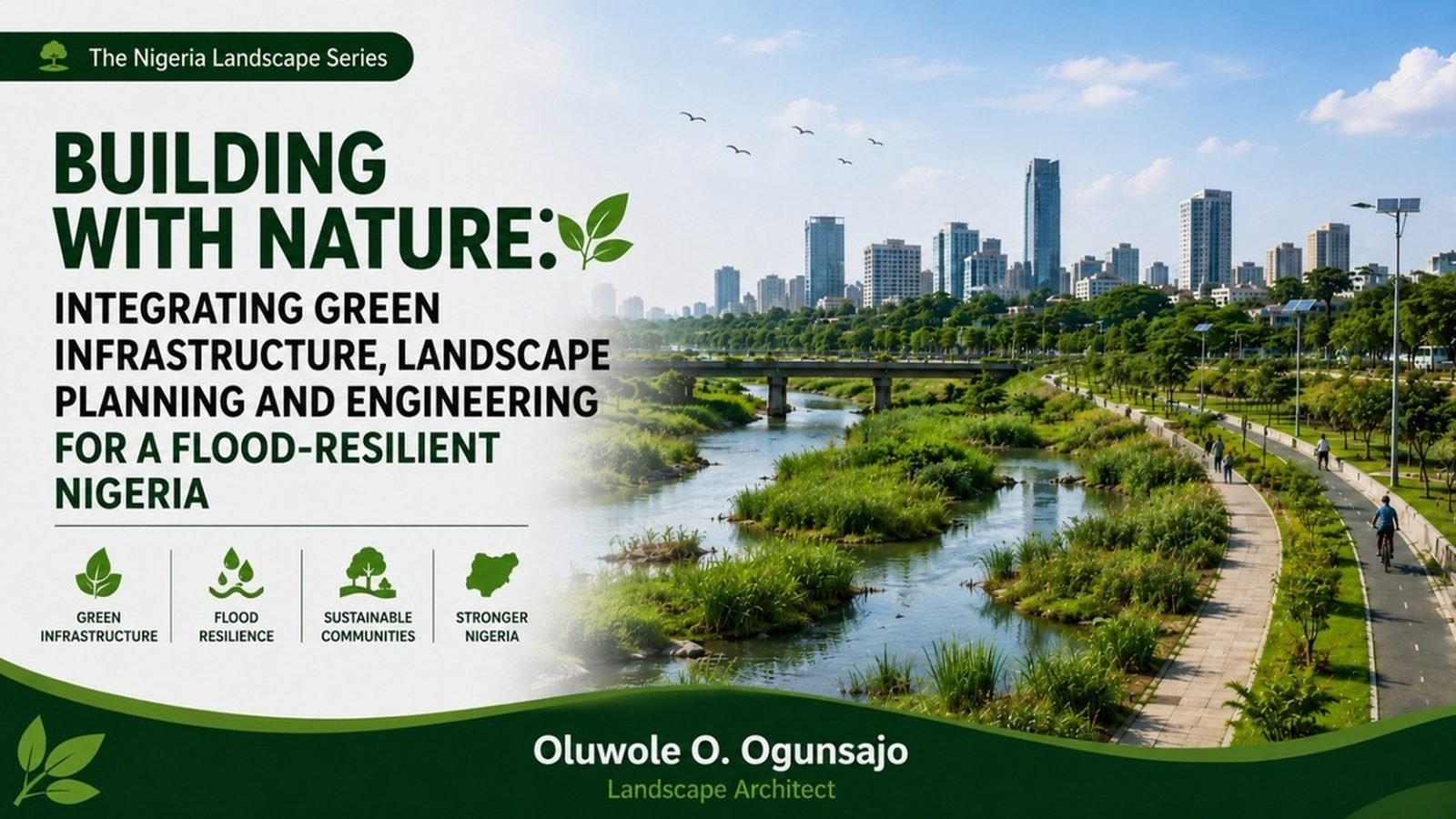
Every rainy season, Lagos reminds Nigerians that flooding is no longer an occasional disaster but a recurring urban crisis. Roads become rivers, neighbourhoods disappear beneath muddy waters, businesses shut down, and thousands of residents are stranded. While heavy rainfall and climate change are often blamed, the deeper problem lies in how we have planned and transformed our landscapes.
While these factors contribute to flooding, they do not tell the whole story.
The uncomfortable truth is that many of Nigeria’s flood disasters are not simply caused by rain. They are the consequence of decades of landscape alteration, weak land-use planning, environmental degradation, and a development model that has steadily disconnected cities from the natural systems that once protected them.
As climate change increases the frequency and intensity of extreme weather events, the need for a new approach has become urgent. If Nigeria is serious about reducing flood risks and building resilient cities, flood management can no longer be viewed solely as an engineering challenge. It must become a landscape planning challenge as well.
The future lies in integrating green infrastructure, sustainable land-use planning, and engineered solutions into a unified strategy. In simple terms, Nigeria must learn to build with nature rather than against it.
Flooding Is More Than a Rainfall Problem
Flooding occurs when water has nowhere to go.
Historically, Nigeria's landscapes were equipped with natural systems that managed excess rainfall effectively. Wetlands stored stormwater, forests absorbed and slowed runoff, floodplains accommodated overflowing rivers, and vegetated landscapes allowed water to infiltrate into the ground.
These ecosystems functioned as nature's drainage network long before modern engineering emerged.
Today, many of these natural systems have been degraded or destroyed. Rapid urbanization has replaced permeable landscapes with concrete, asphalt, and buildings. Wetlands are reclaimed for development. Rivers are confined within artificial channels. Floodplains are occupied by housing estates and commercial projects. Forests are cleared in the name of expansion.
As a result, rainfall that was once absorbed by the landscape now flows rapidly across hardened surfaces, overwhelming drainage infrastructure and increasing the frequency, intensity, and duration of flooding.
The challenge facing Nigeria is therefore not simply how to move water away faster. It is how to restore the natural landscape functions that help manage water in the first place.
Green Infrastructure: Nature's Flood Defence System
Green infrastructure refers to the network of natural and semi-natural systems that provide environmental, social, and economic benefits while supporting climate resilience.
Unlike conventional infrastructure, which relies primarily on concrete and steel, green infrastructure works by mimicking natural processes.
For flood management, this approach offers enormous advantages.
Wetlands: Nigeria's Forgotten Infrastructure
Few ecosystems are as valuable to flood resilience as wetlands.
Often viewed as undeveloped land awaiting reclamation, wetlands are in fact among the most effective natural flood management systems on earth. They act as giant sponges, absorbing and storing excess stormwater during periods of heavy rainfall and releasing it gradually over time.
In addition to reducing flood peaks, wetlands improve water quality, support biodiversity, recharge groundwater, and protect downstream communities from severe flooding.
Nigeria possesses extensive wetland systems, including coastal wetlands, inland floodplains, freshwater swamps, and mangrove ecosystems. Yet many continue to disappear through sand-filling, pollution, reclamation, and uncontrolled development.
Every wetland lost represents the loss of natural flood storage capacity that would otherwise cost millions of naira to replicate through engineered infrastructure.
Protecting and restoring wetlands must therefore become a central pillar of Nigeria's flood resilience strategy.
Urban Forests and Tree Canopy Systems
Trees are often appreciated for their beauty, shade, and environmental value. Their role in flood management, however, is equally important.
Tree canopies intercept rainfall before it reaches the ground, reducing the volume and intensity of runoff. Their roots create pathways that allow water to infiltrate the soil while stabilizing slopes and reducing erosion.
Forests also improve groundwater recharge, moderate local temperatures, and contribute to healthier ecosystems.
Within urban areas, street trees, green corridors, institutional landscapes, community woodlands, and urban forest reserves collectively increase permeable surfaces and improve stormwater management.
For rapidly growing cities such as Lagos, Abuja, Port Harcourt, Ibadan, Kano, and Enugu, urban forestry should no longer be viewed as an aesthetic luxury. It should be recognized as critical infrastructure that contributes directly to climate adaptation and flood resilience.
Parks and Open Spaces as Resilience Infrastructure
Public parks are often designed primarily for recreation. Yet modern landscape planning increasingly recognizes them as multifunctional assets capable of delivering significant flood management benefits.
Well-designed parks can temporarily store excess stormwater during intense rainfall events. Depressions can serve as retention basins, rain gardens can filter runoff, and vegetated landscapes can increase infiltration while reducing pressure on drainage networks.
Around the world, cities are designing parks that function as both recreational spaces and flood management infrastructure.
Nigeria has an opportunity to adopt this approach by ensuring that future public open spaces contribute not only to quality of life but also to environmental resilience.
Landscape Planning Must Come First
Many flood disasters are planning failures long before they become engineering failures. Once development is permitted in the wrong locations, even the most sophisticated drainage infrastructure can only reduce not eliminate the resulting flood risk.
Building flood resilience therefore begins with sound landscape planning.
Floodplains
Floodplains are natural components of river systems, providing space for rivers to safely expand during periods of heavy rainfall. When housing estates, roads, industries, and other infrastructure encroach upon these areas, the river's natural storage capacity is reduced, leading to deeper floods, faster water flows, and greater damage downstream.
Protecting floodplains is not about restricting development; it is about directing development to safer locations while preserving these landscapes for compatible uses such as agriculture, ecological restoration, conservation, parks, and recreation.
Land-Use Planning
Sustainable land-use planning is one of the most effective tools for reducing flood risk.
Development decisions should be informed by flood-risk mapping, watershed characteristics, and long-term environmental considerations rather than short-term economic pressures.
Urban growth should be directed towards suitable land, while wetlands, floodplains, riparian corridors, and other environmentally sensitive areas are safeguarded as critical components of resilient urban landscapes.
Preventing inappropriate development is significantly more cost-effective than attempting to manage recurring flood disasters after construction.
Environmental Assessment
Every major development should undergo a comprehensive landscape and environmental assessment before construction begins.
Beyond meeting regulatory requirements, these assessments should evaluate how proposed developments will affect natural drainage patterns, soil permeability, vegetation, surface runoff, and surrounding ecosystems.
The findings should directly inform site planning, development density, stormwater management, and landscape design. Combined with consistent enforcement of development control regulations, rigorous environmental assessment ensures that growth occurs in harmony with natural systems rather than in conflict with them.
Ultimately, the most resilient cities are not those with the largest drainage channels, but those that respect the landscape's natural capacity to manage water. Good planning remains the first and most cost-effective line of defence against flooding.
Integrating Green Infrastructure with Engineering
Advocating for nature-based solutions does not mean abandoning conventional engineering. Nigeria will continue to require drainage networks, culverts, bridges, pumping stations, and other engineered infrastructure to manage stormwater effectively.
However, engineering alone cannot solve today's flooding challenges.
Traditional flood control systems are designed to convey water away as quickly as possible. While this remains necessary in many situations, these systems become overwhelmed when increasing volumes of stormwater flow rapidly from heavily urbanized landscapes where wetlands have disappeared, trees have been removed, and permeable surfaces have been replaced by concrete.
Green infrastructure addresses this challenge by reducing the amount of stormwater entering engineered drainage systems in the first place. Wetlands temporarily store floodwater, urban forests intercept rainfall, and parks provide space for water retention.
This integrated approach often described as hybrid infrastructure recognizes that neither concrete nor nature alone can provide complete protection against flooding. Instead, each complements the other. Engineering provides structural reliability, while green infrastructure enhances flexibility, adaptability, and multiple environmental benefits.
No Nigerian city demonstrates these challenges and opportunities more clearly than Lagos.
Lagos: A Case Study in Building against Nature
Lagos is a low-lying coastal megacity with an average elevation of approximately 1.5 meters above sea level. Its geography makes it naturally vulnerable to flooding, particularly during periods of intense rainfall and high tidal conditions.
Historically, however, Lagos possessed extensive wetlands, mangrove swamps, floodplains, and open green spaces that functioned as natural drainage systems. These landscapes absorbed stormwater, slowed runoff, replenished groundwater, and reduced flood severity.
Over the past three decades, rapid urbanization has transformed this landscape dramatically.
Large areas of permeable land have been replaced by concrete, asphalt, and buildings. Wetlands have been reclaimed for residential, commercial, and industrial developments. Natural floodplains have been occupied by infrastructure. Green spaces have steadily declined.
As these natural systems disappeared, the city's ability to absorb and manage stormwater declined as well.
Poor waste management has further intensified the problem. Blocked drainage channels, clogged canals, and obstructed gutters reduce the efficiency of stormwater movement, causing water to accumulate on roads and within communities.
The flooding experienced in Lagos today is therefore not merely a hydrological problem. It is fundamentally a landscape planning problem.
The city's experience provides a powerful lesson for the rest of Nigeria: when natural systems are ignored, flood risks increase; when they are protected and integrated into planning decisions, resilience improves.
A New National Mindset
Achieving flood resilience requires more than new infrastructure projects.
It demands a fundamental shift in how Nigeria understands landscapes.
Landscapes are not empty spaces waiting for development. They are living systems that regulate water, support biodiversity, moderate climate, sustain agriculture, and enhance human wellbeing.
Every wetland filled, every forest cleared, every floodplain occupied, and every green space eliminated weakens national resilience.
Conversely, every watershed restored, every urban forest expanded, every floodplain protected, and every intelligently planned neighbourhood strengthens our ability to withstand future climate shocks.
This transformation cannot be achieved by government alone.
Federal, state, and local governments must strengthen planning policies and environmental regulations. Developers must embrace sustainable design principles. Engineers, planners, landscape architects, architects, ecologists, and environmental scientists must collaborate from the earliest stages of project development. Universities must prepare future professionals with interdisciplinary skills, while communities must become active stewards of their local environments.
Flood resilience is ultimately a shared responsibility.
Building the Nigeria 🇳🇬 We Want
Nigeria's future resilience will not be determined by the width of its drainage channels alone.
It will depend on whether we recognize wetlands, forests, parks, floodplains, and green corridors as critical national infrastructure.
We can continue responding to floods after they occur - repairing damaged roads, rebuilding destroyed homes, and counting economic losses every rainy season.
Or we can choose a more intelligent path.
A path where wetlands are protected rather than reclaimed. Where urban forests expand instead of disappearing. Where parks provide recreation and flood protection simultaneously. Where floodplains remain functional. Where land-use planning anticipates risk rather than reacting to disaster.
Most importantly, a path where engineered infrastructure works in partnership with nature instead of attempting to replace it.
Building with nature is not an environmental luxury. It is an economic necessity, a planning imperative, and one of the smartest investments Nigeria can make for a safer, healthier, and more resilient future.
If we truly aspire to build cities capable of withstanding the challenges of a changing climate, then the time has come to stop treating nature as an obstacle to development and begin embracing it as our most reliable partner in progress. That is how we will build a flood-resilient Nigeria.
The cities Nigeria builds today will determine whether future generations inherit recurring flood disasters or resilient landscapes that work in harmony with nature.
Oluwole O. Ogunsajo is a Nigerian Landscape Architect, tourism destination revitalization expert, and Founder of The Nigeria Landscape Series. His work focuses on landscape planning, sustainable urban development, and the transformation of tourism and leisure environments. Through research, professional practice, and thought leadership, he champions landscape-driven solutions that enhance environmental resilience, improve the quality of public spaces, and support Nigeria's sustainable development agenda.
The Nigeria Landscape Series is an educational and professional publication dedicated to promoting landscape architecture, environmental stewardship, resilient infrastructure, and sustainable development across Nigeria.
© 2026 Oluwole O. Ogunsajo. All rights reserved.