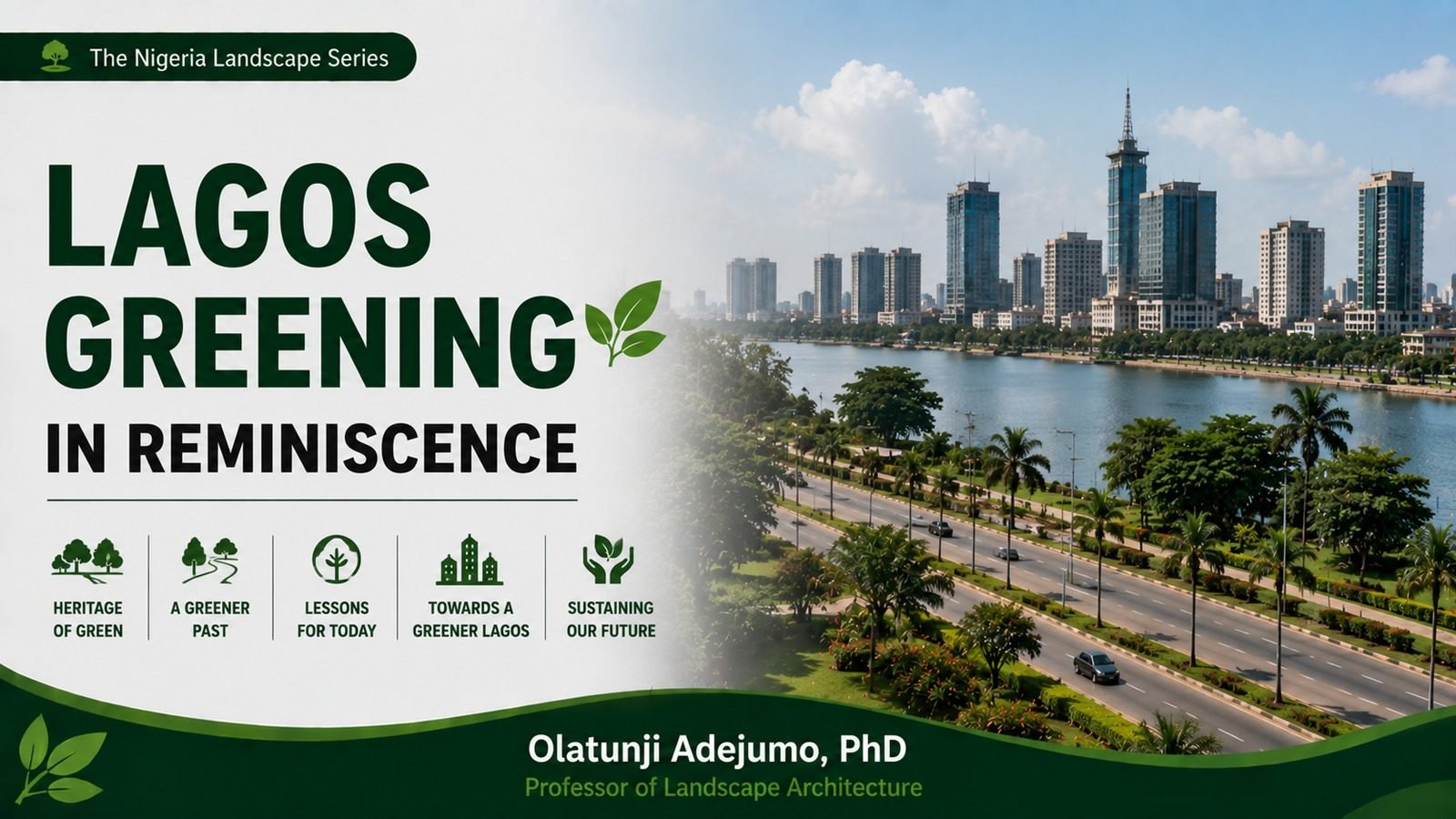
In a world increasingly concerned with pollution, global climate change, vanishing plant and animal species, over-reliance on fossil fuels and inappropriate development of agricultural landscapes, the relationship between cities, nature and sustainability deserves renewed attention.
Urban green spaces are crucial to biodiversity and the quality of urban life. Urban green structure encompasses open spaces ranging from designated public places in downtowns, commercial and industrial districts to private open spaces in residential quarters and services right of ways.
City greening incorporates socio-cultural values into environmentally organized human settlements. Urban parks provide recreational facilities, enhance city aesthetics, improve quality of life, boost real estate, sequester excess carbon and other pollutants, contribute to community vitality and wellbeing, support youth development, provide employment opportunities, promote healthy leisure and strengthen neighbourhood social capital.
These values place planned open spaces among the major physical tools capable of positively influencing the economy, education, health and social life of cities. Planned and natural open spaces together constitute the Metropolitan Open Space System, now referred to as urban green infrastructure.
Historically, Lagos has not been short of urban green resources. Neither has its leadership, from the colonial era through the independent period, been unaware of the benefits of green spaces and the fragile nature of the sand-barrier landscape upon which the metropolis thrives.
LAGOS GREENING - COLONIAL ERA, 1861–1960
The influence of the City Park Movement reached Lagos 25 years after the 1861 dedication of New York Central Park. In 1886, Governor Alfred Moloney established a plant nursery at the site of the Old Debtors Prison at Kokomaiko. Its objective was the experimental cultivation of selected cash crops, including cocoa and coffee, as alternative economic resources for European markets.
In 1887, Moloney established the 1.5-hectare Lagos Botanical Station at Iddo. Plants raised there included para rubber, coffee, cacao, pineapple, casuarina, teak, bougainvillea, plumbago, traveller’s palm and several ornamental and economic species. The Botanical Garden, however, gave way to the Iddo Railway Terminal in 1902.
At the beginning of the twentieth century, Governor MacGregor drained the swamps towards Marina through the construction of what became known as MacGregor Canal. The reclaimed land supported the shaded Marina European Quarters, streets and landscaped residential areas.
Ebenezer Howard’s Garden City philosophy filtered into Lagos through the 1904 Lord Luggard Cantonment Proclamation. Colonial urbanism developed a “Dual City” composed of European Reservation Areas and native quarters. The European Reservation Areas reflected the Garden City model, while native areas retained aspects of the pre-colonial organic landscape, including wide green buffers.
The colonial vision included gardens, extensive public open spaces, recreation grounds, sports fields and shady pathways. Ikoyi became an important expression of this green garden-city model. Ikoyi Park, Ikoyi Cemetery, Ikoyi Golf Club, Obalende Polo Club, Race Course, King George IV Stadium at Onikan, Lagos Yacht Club and the tree-shaded Marina formed a significant planned green network.
The model extended to Apapa, Railway Quarters and Ikeja. Railway Golf Course, Apapa Tennis Club and Ikeja Golf Course supported these developments. Victoria Beach, now Bar Beach, emerged as a prominent waterfront development in the 1930s, while Kuramo Waters served as a youth paramilitary training ground in the 1950s.
Many colonial green spaces were members-only clubs and institutional sports and recreation grounds designed largely for the colonial workforce. Towards the end of colonial rule, private open spaces such as Yoruba Tennis Club, Ikeja Country Club and Isheri Horse Bridle were introduced.
In 1925, a 200-hectare central park was proposed at Iganmu. It was conceived as an iconic metropolitan park associated with transportation, cultural and civic facilities. The park was never designed or built, and the later introduction of the National Art Theatre in 1975 fragmented the space that might have become a major public realm.
The colonial period also witnessed the expansion of institutional green spaces. Military establishments, mission schools and educational institutions were provided with sports fields, playgrounds and landscaped environments. Kings College, Saint Gregory’s College, CMS Grammar School, Igbobi College and Methodist Girls School were prominent examples.
At the same time, vulnerable swamps, flood plains, mangrove forests, low-lying creeks and lagoons were deliberately retained to provide ecological benefits. Rivers, wetlands and other natural systems became important components of the emerging metropolitan green structure.
Street trees provided connecting elements, although one major deficiency was the absence of a well-defined Street Tree Ordinance.
Colonial Lagos can therefore be understood as approximately a century of green-space foundation laying, with emphasis on private gardens, corporate recreation greens, institutional sports spaces and relatively limited attention to the public sphere.
LAGOS GREENING - POST-COLONIAL, 1960–2000
By the late 1950s, attention shifted from gardens, recreation grounds and streetscapes towards the metropolitan fringes and ecological engineering. The Lower Ogun River Forest Reserve was introduced to help check the Ogun River flood regime. This represented a “soft” engineering approach in which natural ecosystems functioned as buffers against flood-related hazards by absorbing storm energy, reducing flow depths and velocities and enhancing sedimentation.
Farm settlements were another important component of this period. The agricultural success of surrounding villages and hamlets had historically supported Yoruba city-states. Obafemi Awolowo adapted the Israeli Kibbutz system to pre-colonial Yoruba rurality, creating nodal farm settlements as part of a regional development philosophy.
Agege Farm Settlement and Badagry Farm Settlement served as productive suburban agricultural green belts intended to support metropolitan food security. The proposed Epe Farm Settlement did not fully materialize, while productive agricultural estates were subsequently undermined by political and administrative changes.
The political upheavals of the 1960s and the civil war years constrained attention to urban aesthetics. During the 1970s and subsequent decades, rapid financial expansion, property acquisition and real-estate pressure contributed to the erosion of earlier greening efforts.
Public green spaces suffered heavily. Ikoyi Park, one of Nigeria’s premier public parks inherited from the colonial period, was subdivided into residential plots and became Park View Estate. Similar pressures affected Ikeja Stadium, the Marina waterfront and other recreational landscapes.
The 1978 Lagos Regional Master Plan and the 1984 Metropolitan Lagos Master Plan attempted to address the problems and reposition Lagos as an environmentally friendly financial hub, but many recommendations were not implemented.
There were nevertheless important interventions. Urban forestry was introduced through street-tree planting, including Azadirachta indica and Delonix regia. The Lagos Horticultural Society worked to establish a 150-hectare Lagos Botanical Garden adjacent to Ologe Lagoon in 1989. Private-sector organisations also became involved in improving streets, clover leaves, roundabouts and highway medians.
The Lagos State Parks Commission Edict of 1985 assigned responsibility for acquiring land and developing parks and recreational facilities, although the corporate body was never constituted and did not handle a single open space.
Forest-reserve proposals at Ologe Lagoon, Lamgbasa shoreline and Agbekin Island were not gazetted. Subsequent speculative development resulted in the loss of more than 4,000 hectares to real-estate development.
In 1988, the Nigerian Conservation Foundation acquired 78 hectares of wetland, later developed as the first private nature reserve in Nigeria.
Other green and recreational assets deteriorated or disappeared. Kuramo Waters was lost to real-estate development, Kweku Biney Zoological Garden and Yaba Love Garden ceased to exist, and the Lower Ogun River Forest was de-reserved in 1995. The devastating consequences of floodplain and forest-reserve loss became evident in subsequent flooding.
FESTAC Town also experienced significant encroachment, with planned green spaces and buffers progressively lost.
Despite these challenges, investment in sports complexes continued. The National Stadium became a major sporting center, while Teslim Balogun Stadium, Agege Stadium, Onikan Stadium and Rowe Park received development or refurbishment.
Nevertheless, the forty-year post-independence period remained one of the darkest phases of green-space development in Lagos, as environmental decency and green-space values were repeatedly sacrificed to private interests and real-estate pressure.
LAGOS GREENING RENAISSANCE - MILLENNIUM PHASE, 2000–2015
The global call for urban greenery gained renewed attention through the Millennium Development Goals. Goal 7 advocated environmental sustainability, while international urban environmental discussions emphasized access to parks, increased tree canopy and protection of critical ecosystems.
The targets included providing access to public parks or recreational open space within half a kilometre of every city resident, maintaining substantial canopy coverage on available sidewalk planting sites and protecting critical ecosystems from unsustainable development.
Lagos responded with renewed planning attention. A review of the 1978 Lagos Regional Master Plan revealed the extent of open-space neglect. By 2002, existing open-space provision stood at only 513 hectares against a population of approximately 12.1 million.
The findings highlighted a severe imbalance between population and planned green space. The international benchmark cited in the study was one planned hectare of green space for approximately 600 people, while densely populated cities such as Mexico City and London adopted higher ratios of approximately 1,000 people per hectare.
Governor Bola Ahmed Tinubu initiated a clean Lagos agenda and established the Lagos State Landscaping and Beautification Committee in 2001. The committee examined recreational and urban-aesthetic deficiencies and identified major highways, arterial streets, loops and intersections for landscape intervention.
Private-sector participation became an important mechanism for public-space improvement. Alausa Park, for example, was refurbished through private-sector involvement.
In 2008, Governor Raji Fashola launched “Operation Green Lagos”. Its objectives included street-tree planting, green lawns along highways and arterial roads, landscaping of clover leaves and development of park-lets, increasing tree canopy, recognizing the capacity of urban trees to sequester carbon dioxide and pollutants, and using regionally native plants for landscape identity.
In 2011, the Lagos State Parks and Gardens Agency, LASPARK, assumed the mandate of improving Lagos’s green spaces. Green streets, landscaped clover leaves and furnished public open spaces became visible elements of the programme.
The reported achievements included millions of trees planted, significant employment generation and extensive tree maintenance.
Urban greening was increasingly connected with climate change. Lagos strengthened climate-change awareness and continued to redefine its tertiary drainage system in response to tidal, pluvial and fluvial flooding.
The Millennium period therefore became a foundation for a Green Lagos Renaissance following decades of urban open-space decline.
LAGOS GREENING - THE FUTURE AND SUSTAINABLE DEVELOPMENT GOALS
The Millennium period created a context for the Sustainable Development Goals adopted in 2015. SDG 11 calls for cities and human settlements to be inclusive, safe, resilient and sustainable.
Target 11.7 focuses specifically on universal access to safe, inclusive, accessible, green and public spaces, particularly for women and children, older persons and persons with disabilities.
For Lagos, the challenge is to localize this goal and revisit earlier targets that remain unrealized. This requires the collective involvement of Lagosians, the public sector, private organisations and communities.
Urban greening is not simply an aesthetic concern. Public parks represent a political expression of metropolitan governance and a response to the socio-cultural needs of citizens, particularly lower-income groups that depend heavily on public spaces.
The scarcity of undeveloped land in metropolitan Lagos means that future green-space provision must rely on the symbiotic relationship between recreation and natural areas.
A park system should provide active and passive recreation at town level, particularly within river valleys, wetlands, lagoons, creeks and waterfronts. The wider Lagos landscape requires an integrated network of parks, wetlands, flood plains and natural drainage systems rather than isolated ornamental spaces.
Earlier planning proposals recommended a system consisting of a park of approximately 10 hectares for each Local Government Council and four community parks averaging two hectares each. Although these recommendations were largely ignored during the post-independence period, the principle remains relevant.
The natural drainage ways and associated wetlands are dominant features shaping the wider Lagos urban area. Their continued encroachment by land speculators and urban squatters must be checked to prevent the final denial of the metropolis’s open-space network.
Development-control provisions and planning legislation must be enforced. Setbacks from the Atlantic Ocean, lagoon shorelines, creeks, rivers and canals are essential. Flood-plain protection must be strengthened, while setbacks from streets, power lines and gas lines should properly define private, semi-public and public spaces.
Planting strips for street trees must also be protected from encroachment.
CONCLUSION
The history of Lagos greening demonstrates that the city has repeatedly recognized the value of vegetation, parks, wetlands, recreation grounds, agricultural landscapes and natural ecological systems.
The challenge has been continuity, protection, implementation and long-term management.
Lagos can no longer afford to treat green spaces as residual land awaiting development. Urban parks, street trees, wetlands, flood plains, waterfronts, agricultural green belts and natural drainage systems must be understood as essential infrastructure.
The future of Lagos depends on reconnecting urban development with its ecological structure.
With effective planning, political commitment, public-private cooperation, professional landscape intervention and firm protection of natural systems, Lagos can rebuild its metropolitan green infrastructure.
By 2030, Lagos Metropolis can become the green megacity of our collective dream.
Olatunji Adejumo is a Nigerian landscape architect, urban designer and Professor of Landscape Architecture. His 40 years of landscape architecture practice span all Nigeria bioregions on site, urban and regional scales honoring projects on nature conservation, ecotourism, environmental impact assessment, university campus planning, regional planning and climate smart agricultural estates. Olatunji Adejumo was one-time President of International Federation of Landscape Architects (Africa Region).
The Nigeria Landscape Series is an educational and professional publication dedicated to promoting landscape architecture, environmental stewardship, resilient infrastructure, and sustainable development across Nigeria.
©2026 Olatunji Adejumo. All rights reserved.