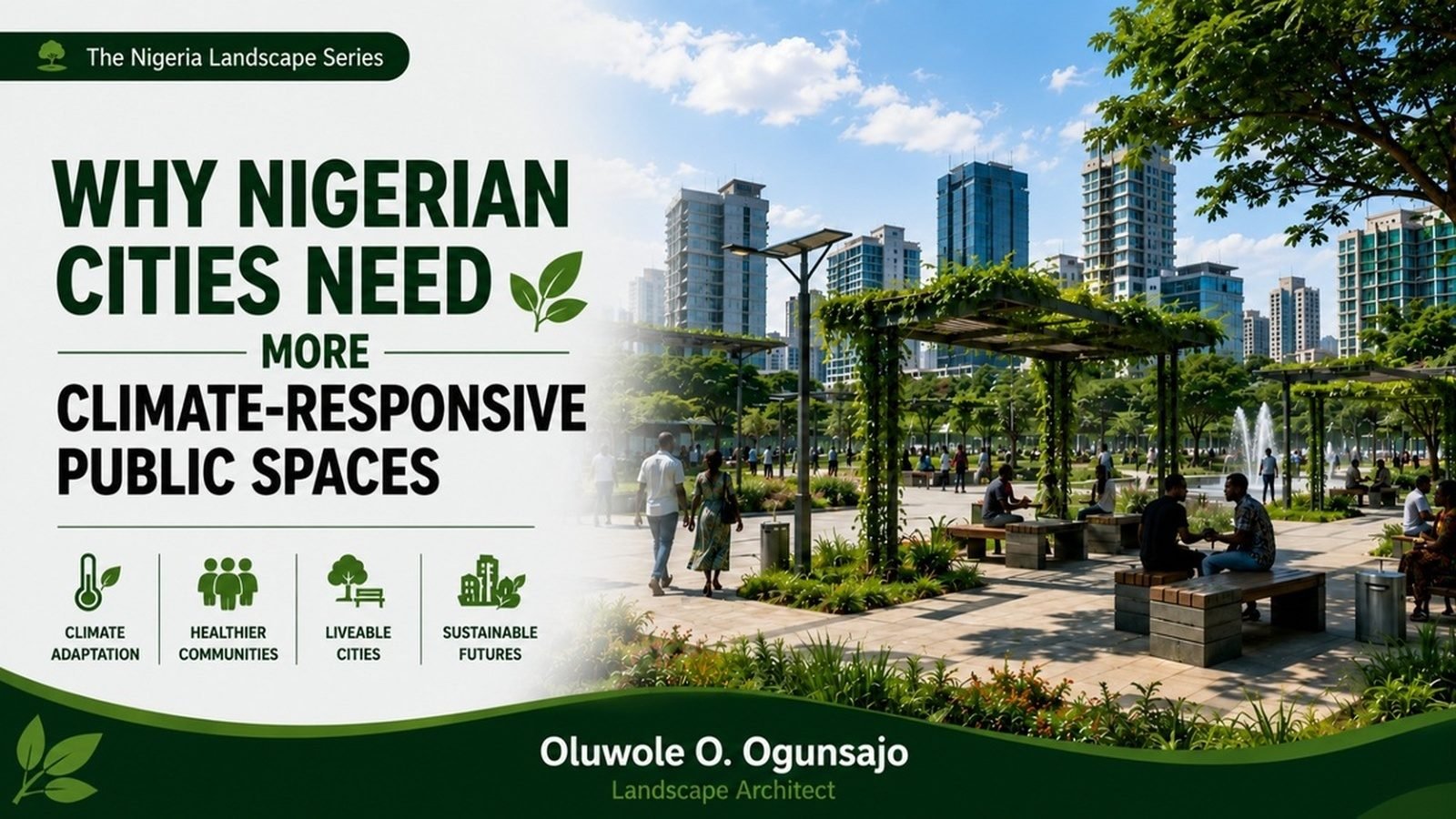
Nigeria is urbanizing at one of the fastest rates in the world. According to The World Bank Group, approximately 54% of Nigeria's population now lives in urban areas, and this proportion is expected to continue rising as cities expand rapidly. Current projections indicate that around 70% of Nigerians will reside in urban areas by 2050. Rapid urbanization presents significant opportunities for economic growth, innovation, and job creation. However, it also places enormous pressure on infrastructure, housing, public spaces, and natural ecosystems. Without deliberate investment in climate-responsive landscape planning, green infrastructure, and nature-based solutions, many Nigerian cities are likely to become increasingly vulnerable to flooding, urban heat stress, biodiversity loss, and environmental degradation.
The economic consequences are equally alarming. A recent World Bank assessment estimated that the 2022 floods caused approximately US$6.7 billion in economic losses equivalent to about 1.6% of Nigeria's Gross Domestic Product (GDP). The floods damaged roads, homes, water infrastructure, and electricity networks, while destroying more than 650,000 hectares of farmland. These figures underscore that investing in climate-responsive public spaces and green infrastructure is far less costly than repeatedly rebuilding after disasters.
In the face of climate change and rapid urbanization, climate-responsive public spaces are no longer optional amenities; they are essential infrastructure. If Nigerian cities are to become healthier, more resilient, and more economically competitive, they must embrace landscape-led solutions that place nature at the center of urban development.
The Hidden Cost of Poor Urban Planning
Every year, thousands of people migrate into cities in search of economic opportunities, placing enormous pressure on existing infrastructure and public services. Unfortunately, much of this growth has occurred without adequate consideration for environmental sustainability. Natural vegetation is routinely cleared for development. Wetlands are reclaimed for construction. Open spaces are converted into residential and commercial developments. Concrete and asphalt continue to replace landscapes that once absorbed rainfall, moderated temperatures, and supported biodiversity. The consequences are visible across the country.
Every rainy season, families lose homes, businesses shut down, commuters are stranded, and billions of naira are lost because our cities were never designed to work with nature. Streets and neighbourhoods are frequently flooded after heavy rainfall. At the same time, cities are becoming hotter due to the Urban Heat Island Effect, where extensive paved surfaces absorb and retain heat throughout the day. Many urban residents also face limited access to safe and functional public spaces. Parks are scarce, recreational facilities are inadequate, and opportunities for outdoor interaction with nature continue to decline. These challenges are interconnected. They are symptoms of urban development that has largely overlooked the role of landscapes in creating resilient and liveable cities.
Economically, flooding damages homes, businesses, roads, and public infrastructure, resulting in significant financial losses. Rising urban temperatures increase energy consumption as residents and businesses rely more heavily on cooling systems. Poorly maintained urban environments can also reduce property values, discourage investment, and limit tourism potential.
Environmentally, the loss of trees, wetlands, and green spaces weakens the natural systems that help cities manage stormwater, improve air quality, support biodiversity, and regulate local temperatures. As climate change intensifies, these vulnerabilities will become even more pronounced.
The social consequences are equally significant. Access to quality public spaces contributes directly to public health, recreation, social interaction, and mental well-being. When cities lack parks, greenways, and attractive public environments, residents lose important opportunities to exercise, relax, and build community connections. In short, the quality of a city's public spaces is closely linked to the quality of life enjoyed by its residents.
What the World Is Doing Differently
Cities around the world are increasingly recognizing that nature can help solve urban challenges.
Singapore has become a global model for integrating green infrastructure into urban development. Through extensive urban greening programmes, interconnected parks, green corridors, and tree-lined streets, the city has improved environmental quality while enhancing urban liveability. In the Netherlands, public spaces are being redesigned to accommodate water rather than simply resist it. Parks, plazas, and open spaces are often designed to temporarily store stormwater during heavy rainfall, reducing flood risks while serving recreational functions during dry periods.
China's Sponge City programme uses wetlands, bioswales, rain gardens, and permeable landscapes to absorb and manage stormwater naturally. The initiative demonstrates how landscape-based solutions can strengthen urban resilience while improving environmental quality. Similarly, cities in North America and Europe increasingly view green infrastructure as a critical component of climate adaptation strategies, investing in urban forests, public parks, ecological restoration projects, and climate-responsive streetscapes.
Lessons from Nigeria's Own Green Spaces
Nigeria already possesses encouraging examples of landscape-led development that demonstrate the value of investing in climate-responsive public spaces. Although they were developed for different purposes, both Lekki Conservation Centre in Lagos and Millennium Park in Abuja illustrate how well-planned landscapes can improve environmental quality, support biodiversity, promote recreation, and enhance urban resilience. These examples show that the foundations for greener, healthier Nigerian cities already exist; what is needed is to replicate and expand such investments across the country.
Lekki Conservation Centre, Lagos

The Lekki Conservation Centre demonstrates the immense value of conserving natural landscapes within rapidly urbanizing cities. Managed by the NCF Nigeria, the Centre protects one of the few remaining coastal rainforest ecosystems in Lagos while serving as a destination for environmental education, recreation, and ecotourism.
Located within one of Nigeria's fastest-growing urban corridors, the Centre provides critical ecosystem services that extend beyond its boundaries. Its extensive vegetation helps absorb carbon dioxide, moderates local temperatures, improves air quality, supports biodiversity, and enhances stormwater infiltration. The protected wetlands also contribute to natural flood mitigation by slowing surface runoff during periods of intense rainfall.
Perhaps most importantly, the Centre offers urban residents an opportunity to reconnect with nature. Features such as the famous canopy walkway, nature trails, bird habitats, and educational facilities demonstrate that green spaces can simultaneously promote recreation, conservation, tourism, and environmental awareness.
Although Lekki Conservation Centre was established primarily for biodiversity conservation, it illustrates a broader principle: well-managed landscapes are essential urban infrastructure. As Lagos continues to expand, similar investments in green corridors, urban forests, wetlands, and public parks could significantly strengthen the city's resilience to climate change while improving residents' quality of life.
Millennium Park, Abuja

The Millennium Park provides another valuable example of how thoughtfully designed public landscapes can enhance urban liveability. As the largest public park in Nigeria's Federal Capital Territory, the park demonstrates the important role that green public spaces play within planned cities.
Its expansive lawns, mature trees, gardens, pedestrian walkways, and open recreational spaces provide residents with opportunities for exercise, relaxation, cultural events, and community interaction. Beyond these social functions, the park contributes to environmental sustainability by reducing the urban heat island effect, improving air quality, supporting urban biodiversity, and increasing permeable surfaces that help absorb rainfall.
Millennium Park also illustrates the economic value of high-quality public landscapes. The park attracts visitors, supports tourism activities, enhances the city's image, and contributes to surrounding property values. These benefits reinforce the growing recognition that investment in public open spaces generates both environmental and economic returns.
While Abuja possesses one of Nigeria's best-planned urban layouts, continued investment in interconnected parks, greenways, urban forests, and climate-responsive streetscapes would further strengthen the city's capacity to adapt to climate change and improve the well-being of its residents.
These examples share a common lesson: successful cities are increasingly treating landscapes as infrastructure rather than decoration.
Why Landscape Architecture Matters
This is where landscape architecture becomes critically important. Landscape architecture is the profession dedicated to planning, designing, and managing outdoor environments in ways that balance human needs with ecological systems. It provides a framework for creating public spaces that are not only attractive but also environmentally functional and socially valuable.
Climate-responsive public spaces are designed to work with nature rather than against it. They can reduce urban temperatures through strategic tree planting and shade provision. They can manage stormwater through rain gardens, wetlands, bioswales, and permeable surfaces. They can improve air quality, support biodiversity, encourage recreation, and strengthen community well-being.
A well-designed park can become a flood management system. A green corridor can function as both a recreational space and a biodiversity habitat. A public square can improve social interaction while reducing surface runoff and urban heat. This multifunctional approach is at the heart of landscape architecture and represents one of the most effective ways of addressing the interconnected challenges facing Nigerian cities.
A Roadmap for Climate-Responsive Nigerian Cities
If Nigeria is serious about building resilient cities, climate-responsive public spaces must become a national priority. Achieving the objectives of the Nigeria Agenda 2050 and the Climate Change Act, 2021 will require cities to move beyond conventional infrastructure by integrating green infrastructure and climate-responsive public spaces into urban planning and development. This shift demands coordinated action by government, planners, developers, and communities. To accelerate this transition, the following actions are essential:
First, government agencies should recognize green infrastructure as an essential component of urban infrastructure alongside roads, drainage systems, and utilities. Second, planning regulations should require climate-responsive landscape design in major public and private developments. Third, existing parks, wetlands, green belts, and urban forests should be protected from encroachment and unsustainable development. Fourth, cities should invest in large-scale urban tree planting and canopy restoration programmes designed to deliver measurable environmental benefits. Fifth, tourism and destination development projects should incorporate landscape-led planning to improve environmental quality, visitor experiences, and long-term sustainability.
The Time to Act Is Now
Climate change is no longer a future threat; it is a present reality. Nigerian cities are already experiencing its impacts through flooding, rising temperatures, environmental degradation, and declining public spaces. Fortunately, solutions exist.
Climate-responsive public spaces offer one of the most practical, cost-effective, and sustainable responses to many of the challenges facing our cities today. They improve environmental performance, strengthen social cohesion, support economic growth, and enhance urban resilience.
The future of Nigerian cities cannot be built on concrete alone. It must also be built on landscapes. The question is no longer whether Nigeria can afford climate-responsive public spaces. The real question is whether our cities can afford to keep developing without them.
The time has come for Nigeria to place landscape-led solutions at the center of its urban future.
Oluwole O. Ogunsajo is a Nigerian Landscape Architect, tourism destination revitalization expert, and Founder of The Nigeria Landscape Series. His work focuses on landscape planning, sustainable urban development, and the transformation of tourism and leisure environments. Through research, professional practice, and thought leadership, he champions landscape-driven solutions that enhance environmental resilience, improve the quality of public spaces, and support Nigeria's sustainable development agenda.
The Nigeria Landscape Series is an educational and professional publication dedicated to promoting landscape architecture, environmental stewardship, resilient infrastructure, and sustainable development across Nigeria.
© 2026 Oluwole O. Ogunsajo. All rights reserved.