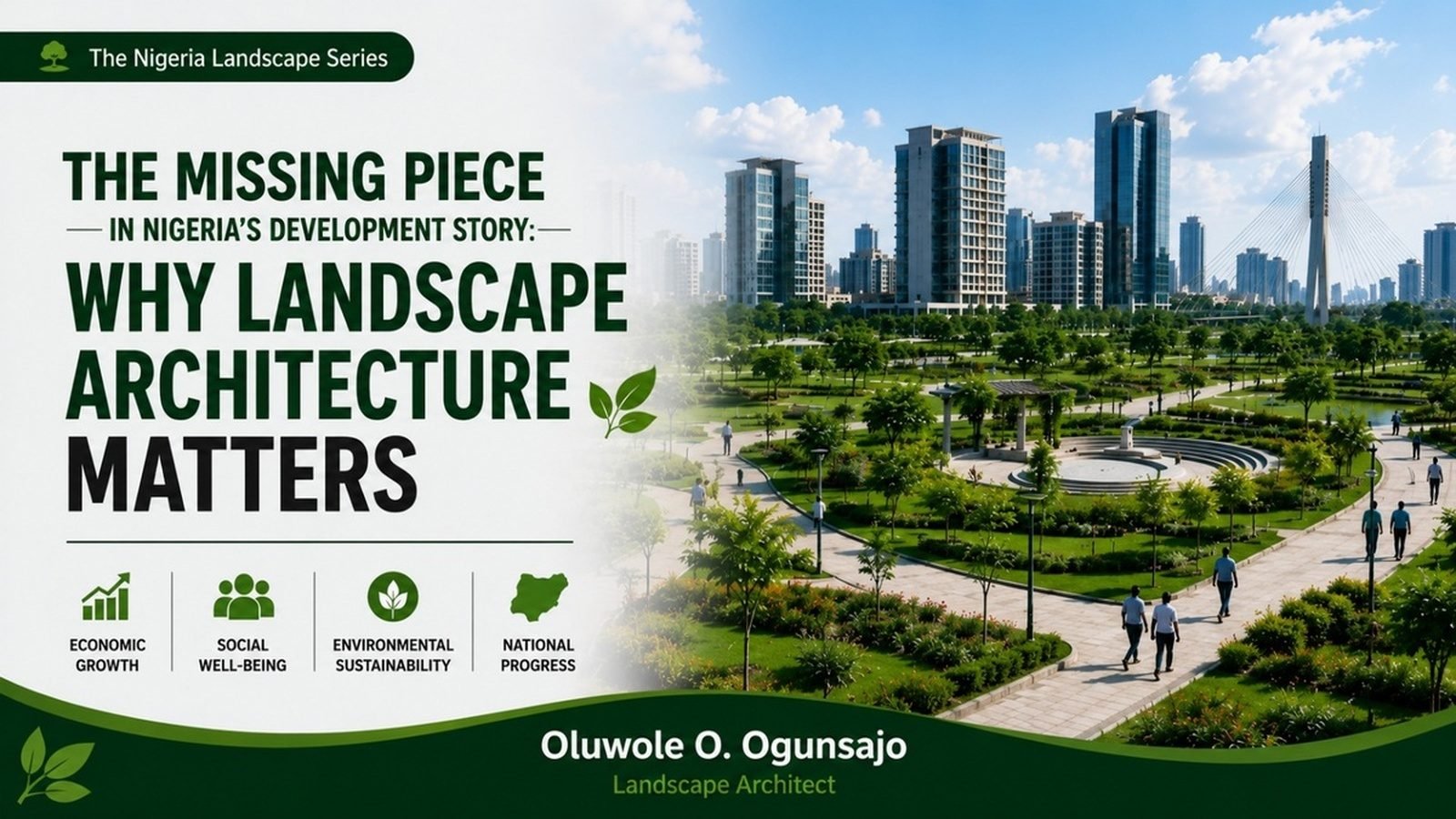
Every major road, bridge, housing estate and industrial park ultimately depends on the quality of the landscape that surrounds it. Yet in Nigeria, one of the professions best equipped to shape these environments remains largely absent from national development planning.
Across the world, Landscape Architects help nations create healthier cities, resilient communities, productive public spaces, and environmentally sustainable infrastructure. In Nigeria, however, the profession remains underutilized despite the growing challenges of urbanization, climate change, environmental degradation, and declining public spaces.
Nigeria's Development Challenge
Nigeria is urbanizing at an unprecedented rate. Cities such as Lagos, Abuja, Port Harcourt, Kano, and Ibadan continue to expand rapidly, often without adequate planning for open spaces, green infrastructure, pedestrian networks, stormwater management, and environmental protection.
The result is visible everywhere. Flooding has become a recurring challenge in many urban areas. Public parks are scarce and poorly maintained. Urban heat is increasing due to excessive concrete development and loss of vegetation. Road corridors are designed primarily for vehicles with little consideration for pedestrians, cyclists, or environmental sustainability.
Many public projects focus almost exclusively on buildings and engineering structures while neglecting the surrounding landscape systems that determine long-term functionality and quality of life. Consequently, cities become less livable, less resilient, and more expensive to maintain. This planning gap represents a significant missed opportunity for national development.
Economic, Environmental and Social Benefits
The implications extend far beyond aesthetics.
Economically, well-designed landscapes increase property values, attract investment, support tourism, and reduce infrastructure maintenance costs. Green urban environments make cities more attractive to businesses, investors, and skilled professionals. Tourism destinations, parks, waterfronts, and recreational facilities also generate employment and stimulate local economies.
Environmentally, landscape architecture provides practical solutions to some of Nigeria's most pressing challenges. Trees and green spaces help reduce urban temperatures, improve air quality, control erosion, and manage stormwater. Properly planned landscapes can significantly reduce flooding risks while enhancing biodiversity and ecological stability.
Socially, public spaces contribute to healthier and safer communities. Parks, plazas, recreational facilities, and green corridors encourage physical activity, social interaction, and community cohesion. Numerous studies worldwide have linked access to green spaces with improved mental health, reduced stress levels, and enhanced overall well-being. As Nigeria's population continues to grow, these benefits become increasingly important for sustainable development.
Lessons from Global Best Practice
Many nations have recognized landscape architecture as a strategic component of national development.
In Singapore, landscape-led planning has transformed the city-state into what is globally known as a "City in Nature." Green infrastructure is integrated into transportation systems, housing estates, commercial districts, and public spaces. The result is a highly livable urban environment that supports economic competitiveness and environmental sustainability.
In the Netherlands, landscape architects play a central role in water management and climate adaptation. Their expertise helps protect communities from flooding while creating multifunctional public spaces that serve both environmental and social purposes.
China has invested heavily in the development of "Sponge Cities," where landscape-based solutions such as wetlands, parks, bioswales, and green corridors are used to absorb stormwater, reduce flooding, and improve urban resilience.
Meanwhile, cities such as Copenhagen, Melbourne, and Vancouver increasingly rely on landscape architects to address climate change, urban heat, biodiversity conservation, and public health challenges. These examples demonstrate that landscape architecture is not merely about beautification; it is a strategic tool for national growth and resilience.
Landscape Architecture as National Infrastructure
Landscape Architecture offers an integrated approach to planning, design, and environmental management. Unlike traditional approaches that focus solely on individual buildings or infrastructure components, landscape architects consider the broader relationship between people, nature, and the built environment.
The profession brings together ecology, urban planning, environmental science, horticulture, engineering principles, and design thinking to create sustainable solutions. For Nigeria, this means designing flood-resilient communities, restoring degraded ecosystems, revitalizing tourism destinations, creating functional public parks, improving transportation corridors, enhancing institutional campuses, and developing climate-responsive cities.
Landscape architects can also contribute significantly to national priorities such as food security through productive landscapes, environmental restoration through afforestation and habitat conservation, and economic diversification through tourism development. By integrating landscape architecture into development planning, government projects can achieve greater environmental performance, social value, and long-term economic returns.
A Policy Agenda for Nigeria
To fully harness the benefits of landscape architecture for national development, several actions are necessary.
First, landscape architects should be included from the earliest stages of public project planning rather than being engaged only after construction decisions have been made.
Second, federal, state, and local governments should prioritize the development and maintenance of green infrastructure as an essential component of urban infrastructure.
Third, landscape planning should become a mandatory requirement for major public developments, transportation projects, housing estates, educational institutions, healthcare facilities, and tourism destinations.
Fourth, professional awareness should be increased among policymakers, developers, and the general public regarding the economic and environmental value of landscape architecture.
Fifth, investment should be made in urban forestry programs, public parks, green corridors, waterfront developments, and ecological restoration initiatives across Nigerian cities.
Finally, stronger collaboration among landscape architects, urban planners, architects, engineers, environmental professionals, and government agencies is necessary to deliver integrated and sustainable development outcomes.
Nigeria's development aspirations cannot be achieved through buildings and infrastructure alone. Sustainable national development requires environments that are functional, resilient, healthy, and capable of supporting both people and nature.
Landscape Architecture provides the framework for achieving these goals. It transforms open spaces into productive assets, converts environmental challenges into opportunities, and enhances the long-term value of public investments.
Looking Ahead
As Nigeria continues to build its future, it is time for policymakers, developers, institutions, and communities to recognize landscape architecture not as an optional aesthetic addition, but as an essential driver of national development.
The question is no longer whether Nigeria needs landscape architecture. The real question is whether Nigeria can afford to continue developing without it.
Every road, housing estate, industrial park, tourism destination and public institution should begin with landscape planning - not as an afterthought, but as a foundation for sustainable development. The future of Nigeria's cities will depend not only on what we build, but on how wisely we shape the landscapes around them.
Oluwole O. Ogunsajo is a Nigerian Landscape Architect, tourism destination revitalization expert, and Founder of The Nigeria Landscape Series. His work focuses on landscape planning, sustainable urban development, and the transformation of tourism and leisure environments. Through research, professional practice, and thought leadership, he champions landscape-driven solutions that enhance environmental resilience, improve the quality of public spaces, and support Nigeria's sustainable development agenda.
The Nigeria Landscape Series is an educational and professional publication dedicated to promoting landscape architecture, environmental stewardship, resilient infrastructure, and sustainable development across Nigeria.
© 2026 Oluwole O. Ogunsajo. All rights reserved.